
Oldham County Projected Release Dates
A projected release date is TDCJ's current estimate of when a state prisoner may leave custody, based on the sentence and information in its system. It is not the same as parole eligibility, mandatory-supervision eligibility, maximum expiration, discharge, or actual release. Parole eligibility is the first lawful point for review. Maximum expiration marks the end of the sentence as calculated. Discharge means the sentence or supervision obligation has ended. Actual release is the physical custody event.
Oldham County Jail records require a different reading. A person held before trial has no projected sentence-completion date. Release may follow bond, dismissal, disposition, or a court order. A person serving a county sentence may have a calculation based on the judgment, jail credit, any local deduction, and holds. The TDCJ online date should not be applied to either a pretrial detainee or a county-only sentence.
Lookup Oldham County Release Dates
Start by identifying the system. Oldham County Jail is a county facility run by the sheriff. TDCJ is the statewide prison system. The agency that computes the date must answer questions about that calculation. A court file can establish the sentence, jail credit, and later orders, but it does not replace the custodian's release event.
- Confirm whether the person is pretrial, serving a county sentence, or in TDCJ custody.
- For TDCJ, search by name, TDCJ number, or SID and open the matching record.
- Copy the date with its exact label, such as projected release or maximum expiration.
- For an Oldham jail sentence, ask the sheriff and clerk for the judgment, credit, holds, and release calculation.
- Check parole status or court orders when they affect the expected event.
- Verify physical departure with the agency that held the person.
The TDCJ Inmate Search provides the state-prison starting point. Its fields include first and last name, TDCJ number, State Identification number, sex, and race. Exact identifiers reduce false matches.
| Search field | Best use |
|---|---|
| TDCJ number | Directly narrows the state corrections record when known. |
| SID number | Uses the Texas State Identification number tied to the person. |
| Name | Starts a broader match that needs identity checks. |
| Sex and race | Further narrow a name search; they do not prove identity alone. |
The official manifest capture shows the search interface. Open the live TDCJ search to check current labels.
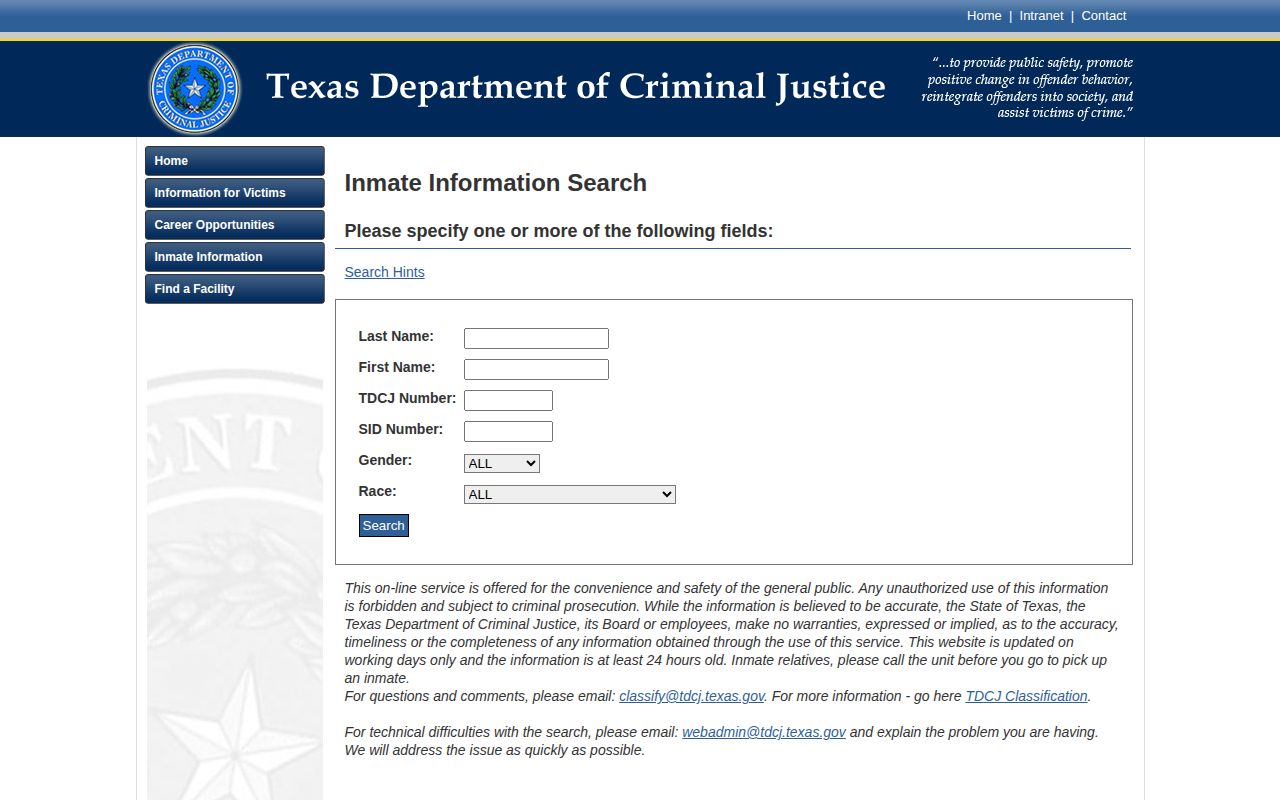
A public detail screen should be used only after the identity is resolved. If the online search does not answer the question, TDCJ also provides email and telephone information routes.
Oldham County Release Date Channels
TDCJ's email service can provide current location, offense, sentence, and projected release information when available. The request should include a full name and either a TDCJ number, SID, or exact date of birth. TDCJ states that the email information service has no charge. Telephone information is available at 936-295-6371 or 800-535-0283 during the published weekday service hours. Those routes help when the online record is unclear or does not resolve the person.
For a dispute about a TDCJ time or release calculation, Classification and Records is the focused route at 936-437-6231 or classify@tdcj.texas.gov. A Public Information Act request serves a different purpose: obtaining copies of releasable records. Ask the time-calculation office to explain or correct a date. Use the records process to obtain the documents behind it.
For Oldham County Jail, call 806-639-2174. Ask for the sentence, jail credit, any local good-conduct deduction applied, holds, and the actual release calculation. The combined clerk can supply the judgment and relevant court orders. No official Oldham online calculator or published local good-time policy was found.
Note: Use Classification and Records for a disputed TDCJ calculation; use a records request when copies of the source documents are needed.
Texas Rules for Oldham Release Dates
Texas has no blanket rule that all people convicted of a violent offense serve 85 percent. The correct formula depends on the offense, offense date, sentence, findings, and governing statute. Government Code Chapter 498 controls state good-conduct time. Section 498.003 awards credit according to classification and qualifying activity, including limited additional credit for diligent participation described by law. Section 498.004 permits forfeiture and addresses restoration.
The key limit appears in Government Code Section 498.005: good-conduct time affects eligibility for parole or mandatory supervision and does not otherwise reduce the judicial sentence. For ordinary cases under Section 508.145(f), calendar time plus accrued good time generally reaches parole eligibility at one-fourth of the sentence or 15 years, whichever is less. That is an eligibility point, not a release order.
For offenses and findings covered by Section 508.145(d), calendar time without good-time credit generally must equal half the sentence or 30 calendar years, whichever is less, with a two-year floor. Other subsections create special thresholds. Sections 508.147 through 508.149 govern mandatory supervision, including exclusions and discretionary review for eligible post-September 1, 1996 cases. The BPP may deny release or require steps before it occurs.
County jail good time is separate. Code of Criminal Procedure Article 42.032 permits a sheriff to deduct up to one day for each day actually served for good conduct, industry, and obedience. The word “may” makes the deduction discretionary. Because no Oldham policy was found, the amount cannot be assumed from the statute alone.
The manifest includes the official Chapter 498 source. Review the published Texas good-conduct-time chapter for the controlling text.
The statute must be applied to the real case facts. A simple percentage cannot replace that review.
Why Oldham Release Dates Change
A date can move even when the original sentence remains the same. TDCJ may receive corrected jail credit or sentence data. Classification can change, good time can be forfeited or restored, and disciplinary action can affect the calculation. Parole or mandatory-supervision decisions can also change which date the public record displays.
| Factor | Possible effect |
|---|---|
| Corrected sentence or jail credit | Changes the inputs used to calculate time already served or remaining. |
| Good-time status | Classification, forfeiture, or restoration can move an eligibility calculation. |
| BPP action | Denial, approval, or prerequisites may shift the expected path or displayed date. |
| Detainer or hold | Another authority may take custody even when one sentence permits release. |
| Consecutive sentence | One term may have to follow another before community release. |
| Court or appellate order | A new judgment, credit ruling, remand, or other order can alter the controlling record. |
| Administrative processing | Required checks and release steps can separate approval from physical departure. |
A detainer is a notice that another authority may seek custody. A remand sends a matter or person back under a court's order. Neither should be described as a community release. Program prerequisites and a later BPP vote may also stand between eligibility and departure.
No Oldham 85-Percent Shortcut
The Texas formulas are the distinctive point for an Oldham County release-date lookup. Ordinary parole eligibility may combine calendar time and good time at the one-quarter or 15-year threshold. Covered serious offenses generally use calendar time at the half-sentence or 30-year threshold without good-time credit in that formula. Special offenses can follow still other rules.
That framework is why an “85 percent” answer is not reliable in Texas. State good time concerns eligibility, while the BPP controls discretionary parole decisions. Mandatory supervision has its own exclusions and review. County jail credit under Article 42.032 is a different discretionary process administered locally. The source, label, and custody system must stay attached to every date.
Note: A parole eligibility date opens review; it does not promise a favorable vote or completed release processing.
Confirm Oldham County Actual Release
When the expected date is near, check the source again. Ask TDCJ about a state-prison date and the Oldham sheriff about a county-jail calculation. A favorable parole vote may still involve program steps and administrative processing. For post-approval physical release questions, the research identifies the TDCJ release-processing line at 512-406-5202.
VINE can send a custody-change alert for a matched participating-agency record. The Oldham County VINE inmate check explains how to register and how to read the reporting agency. Keep in mind that a VINE event may lag, and departure from one agency can be a transfer rather than freedom from custody.
The final proof is the actual release or transfer record from the agency that held the person. Preserve each date with its label and source. That practice keeps a projected date, an eligibility milestone, and an actual departure from being mistaken for one another.
If the displayed TDCJ date changes, save the earlier label and access date before contacting Classification and Records. Ask which input changed, such as jail credit, sentence data, classification, or a release decision. If an Oldham jail calculation is disputed, compare the sheriff's calculation with the judgment and clerk file. A clear question about one date is more useful than a request for a broad estimate.
Release to parole or mandatory supervision is still a release from prison custody, but it is not full discharge. The person remains under TDCJ Parole Division supervision until the applicable obligation ends. Completion of a county sentence, transfer to another authority, and release after bond are also distinct events. Record the exact status so the date does not imply more than the official source states.